
Growing the gap: IaaS market three years in a row

Jukka Dahlbom • 5. elokuuta 2014

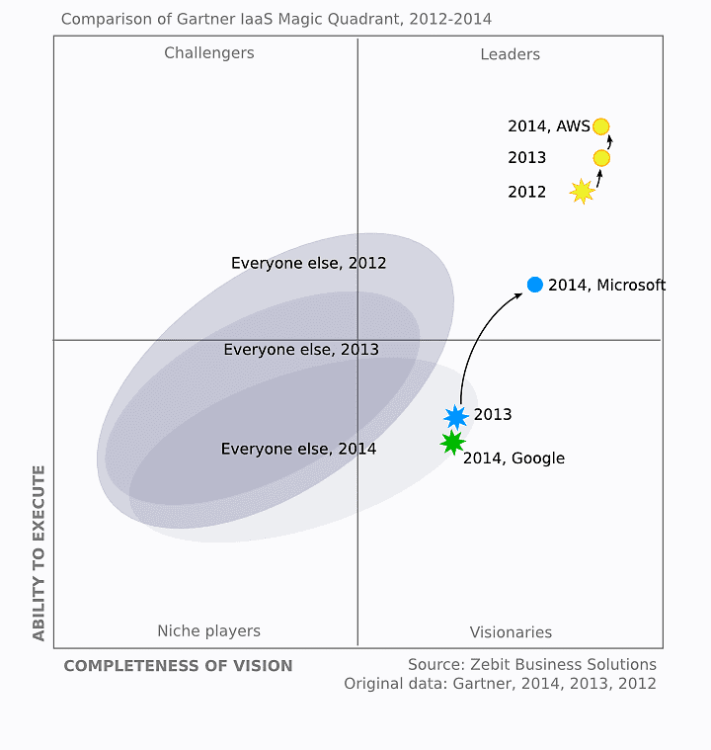
Gartner recently released their 2014 IaaS Magic Quadrant [ 1 ] report, covering 20 major players in the Infrastructure-as-a-Service market. Amazon Web Services is leading the IaaS market by a massive margin, as it has been since 2012 when the first such report was published.

What is noteworthy – and not obvious by looking at just 2014 report – is that AWS is outpacing its competitors, growing the gap each year even though the market as a whole has evolved significantly during this time.

Other major changes in the market this year were the entry of Google into the IaaS market with their Google Compute Engine, and the grand leap to Leader quadrant by Microsoft Azure offering.

Gartner only included cloud compute IaaS in their Magic Quadrant, not including storage, cloud brokerage or hardware and software providers intended for building cloud infrastructure. Heavy emphasis was in self-service and automation in a standardized environment – the primary context being enterprises with the desire to have a cloud “data center”. Evaluation focused on the common requirements for these customers.

The report does a good apples to apples comparison, which is rare in this market: Certain providers are explicitly called out as cloudwashing their dedicated managed services into “IaaS”.

Evaluated companies in general could promise monthly compute availability SLAs of 99.95% and higher, which is typically higher than availability SLAs for managed hosting. All the companies are believed to be financially stable, with business plans that are adequately funded. Customers should not need to worry about them going out of business.

The API supported by each provider is also mentioned – the Amazon Web Services (AWS), OpenStack and vCloud being the most common. It is essential to understand that even though the API might be identical between providers, there is likely to be no interoperability of services. OpenStack implementation especially differs from provider to another, rendering the hyped lack of vendor lock-in practically false.

Google entered the IaaS market only recently with their general availability launch in December 2013. Although Google entered the market very late in the game, Gartner considers that their ability productize existing capability instead of building from scratch will enable them to move significantly faster than most competition. Productizing existing capacity also means that their cost of service is very low. The effect of GCE pricing has already pushed Amazon into lowering their entry-tier compute pricing. As of now, AWS T2-tier is the most inexpensive option.

Mirosoft Azure business was previously strictly PaaS, but with the launch of Infrastructure Services, Microsoft entered the IaaS market in April 2013. It is already second in IaaS market share, far ahead of the smaller competitors – even if it is still far from Amazon

As downsides to Azure IaaS offering, Gartner sees the lack of support for complex network topologies and Microsoft centricity, as shown by lack of enterprise Linux options. Azure Infrastructure Services appeals primarily to .NET developers, even though running heterogenous loads is possible.

The growing gap between AWS offerings and other providers, together with the fact that the developer ecosystem for AWS is superb, strengthens our belief that Amazon Web Services should be the standard part of every highly productive developers choice of tools. Whether we are migrating a customers enterprise system off premises, or creating their brand new global flagship service, AWS provides us as developers with a scalable, inexpensive and reliable service without limiting our freedom of building just the right kind of solution.

Interested in how your organization could be more agile and save in costs with AWS? Contact us at  info@webscale.fi

Viimeisimmät kirjoitukset

AWS DevOps Agent
8. joulukuuta 2025
AWS:n DevOps Agent on autonominen virtuaalinen on-call-tiimikaveri, joka tutkii häiriöt automaattisesti, kokoaa tilannekuvan useista järjestelmistä ja ehdottaa korjauksia keventäen SRE-tiimien kuormaa.
4. joulukuuta 2025
AWS tuo uudenlaista joustavuutta palveluihin yhdistämällä serverless-mallin ja perinteisen instanssihallinnan. Uudistus hämärtää rajaa Lambdan ja EC2:n välillä, kun funktiot voidaan ajaa valituilla instanssityypeillä AWS:n edelleen hoitaessa skaalauksen ja ylläpidon.
24. marraskuuta 2025
Deploying software on EC2 instances nowadays feel like going backwards in time - most of the applications would be usually preferably deployed as Docker containers or serverless functions.
18. kesäkuuta 2025
Kesäkuun alussa suuntasimme aurinkoiseen Tukholmaan AWS:n järjestämään Partner Summitiin ja sitä seuranneeseen Summit -päätapahtumaan.
Lisää kirjoituksia